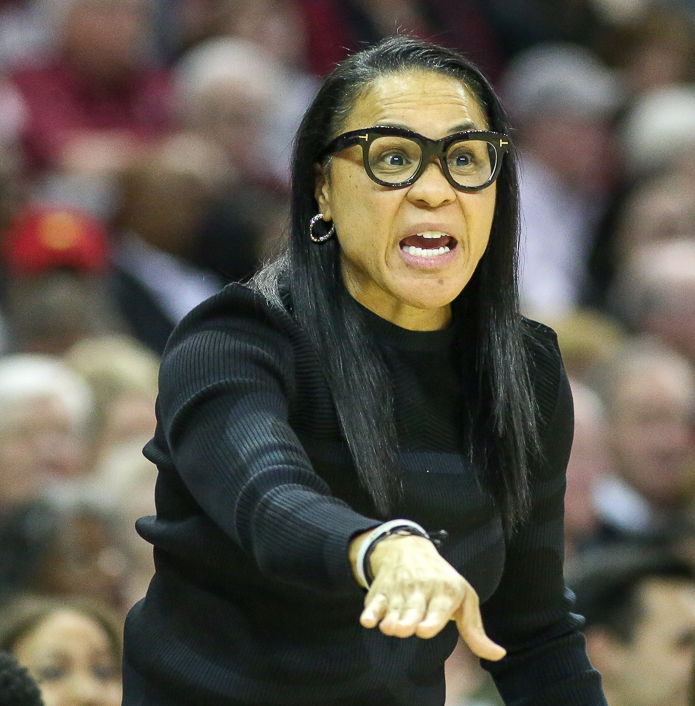
Staley
She built it. They came.
How South Carolina became proof of what happens when women's basketball is built to matter.
Who she is.
When Dawn Staley took over South Carolina in May 2008, the Gamecocks were an afterthought in the SEC. She did not inherit a giant. She built one.
Eighteen seasons later, South Carolina is the standard the rest of the sport measures itself against — three national championships, a perfect season, and the loudest building in women's basketball. The case for Staley isn't that she coached great teams. It's that she manufactured greatness where there wasn't any.
The thing she created.
A defensive, rebounding-first identity that never leaves the floor — the thing every Gamecock team is known for before it's known for anything else.
A destination. Columbia went from a place recruits overlooked to a place the best players in the country choose, develop, and leave as No. 1 picks.
A crowd. Not a fanbase that shows up when the team is good — a fanbase that made showing up the point, and turned Colonial Life Arena into the sport's home-court advantage.
The defining moments.
South Carolina wins its first national championship — the program's arrival as a blue blood, not a Cinderella.
A second national title behind National Player of the Year Aliyah Boston confirms the standard is permanent.
A 38–0 national championship season — the 10th undefeated team in Division I history — caps three titles in eight years.

We don't tell you she mattered. We show you what changed.
Average home attendance at Colonial Life Arena (capacity 18,000). South Carolina has led all of women's college basketball in attendance for 11 straight measured seasons.
+5,992 in a single season (2014-15) — the largest one-year attendance jump in the sport when it happened.
- 10 SEC regular-season championships
- 9 SEC Tournament championships
- 8 Final Fours in 11 tournaments
- 2 No. 1 overall WNBA draft picks developed
Where we still see her.
The blueprint: every program now selling defense, rebounding and depth is chasing the identity South Carolina made non-negotiable.
The expectation that a women's basketball program can be a top-of-market attendance draw — not a break-even line item.
A generation of post players who saw Wilson and Boston go No. 1 and believed the same path was theirs.
History isn't finished.
She didn't wait for women's basketball to become the main event. She built a program that acted like it already was — and the country showed up to prove her right.
Look what she built.